groupby in pandas.
Why entities need care
Entity columns are the columns required to uniquely identify a row. Because of that, a combination of entity values can never repeat — which makes removing or changing entities a delicate operation that can corrupt the data if done carelessly. Say you have a dataset with Date and Country as entities, the most common combination in Alphacast. You will have many rows for the same date, one per country. You cannot simply drop the Country column, because dates would then repeat and entity combinations must be unique.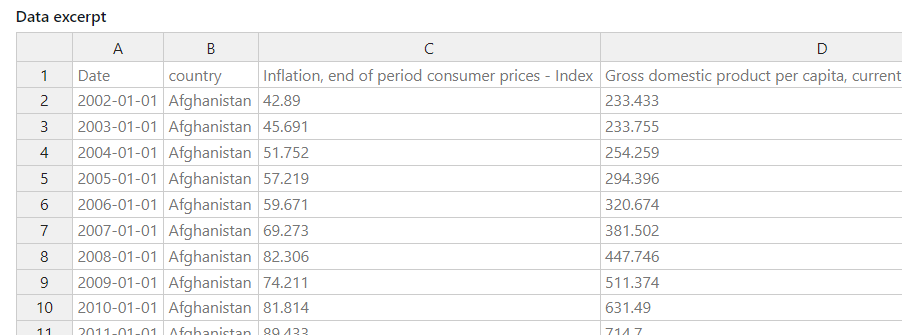
How to regroup
1
Create a pipeline and select the source
Start from a Fetch Dataset step.
2
Add the Regroup Entities step
3
Choose which entities to drop
Deselect the entities you want to remove.
4
Choose the aggregation per column
Decide how rows that now share the same entity values should be combined — the Date, in the example above.The aggregation is set per column, so different columns can be combined differently in the same step. The right choice depends entirely on what each column represents.
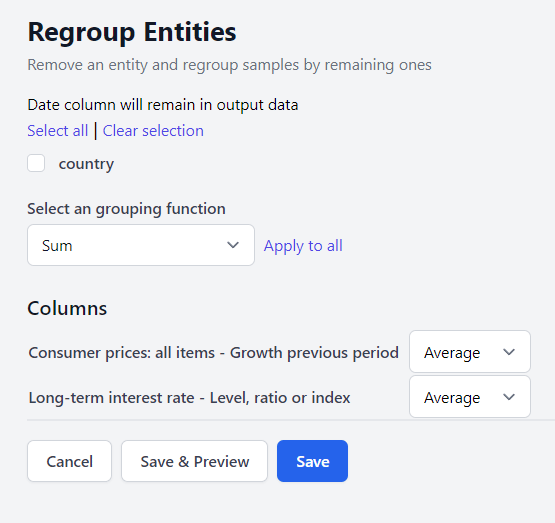
This step uses the fixed list of aggregations above, not the formula editor. To compute a value that isn’t in the list, add a Calculate Variable step before or after regrouping.
Next steps
Calculate variable
Compute values the fixed aggregations don’t cover.
Change frequency
Aggregate along the time dimension instead.